
From an AI idea to a live platform
Helps businesses understand their brand, create content and creative assets, and publish to social channels. Built from scratch.
What we did

We turned an AI marketing idea
into a production-ready platform built around real workflows.
The client came to us with an idea: use AI to help businesses understand their brand, create marketing content, generate creative assets, and publish across social channels.
The challenge was bigger than building an AI content generator. The platform needed persistent brand intelligence, multiple AI workflows, asynchronous image and video generation, social publishing, subscriptions, credits, teams, administration, and integrations — all working together as one SaaS product.
We built the platform from the ground up, turning an AI concept into a production application designed for real users, real usage, and real operating costs.
Services
Industries
Highlight
Technologies
An AI demo is easy.
A marketing platform is not.
The client needed more than a model that could generate a caption. The product had to understand each business, preserve its brand context, coordinate several AI workflows, manage expensive generation jobs, connect to external platforms, and support the commercial infrastructure behind a SaaS business.
01
AI needed business context
Generic prompts produced generic results. The platform needed to understand a company's mission, audience, positioning, tone, visual identity, colors, typography, competitors, and marketing goals — and make that information available across future workflows.
02
AI generation could not block the product
Images and videos can take significantly longer to generate than normal API requests. Users needed to be able to continue working while those jobs ran in the background.
03
Different jobs needed different AI capabilities
Content generation, strategic reasoning, image generation, and video generation have different requirements. The platform needed an architecture that could use multiple AI providers rather than forcing every workload through one model.
04
AI had to operate inside a real SaaS
Authentication, teams, permissions, subscriptions, credits, payments, usage tracking, administration, analytics, and integrations were all part of the product. AI was one capability inside a much larger system.
05
Every generation has an operating cost
Generating content and creative assets indiscriminately can quickly become expensive. The product needed to make AI usage measurable and controllable, while giving customers a clear credit-based model.
Scope of work
Explore all our servicesProduct foundation
- SaaS architecture
- Frontend
- Backend
- Authentication
- Core user workflows
AI & brand intelligence
- Brand profiling
- AI assistants
- Content generation
- Strategy
- Image generation
- Video generation
Platform engineering
- Database
- Teams
- Permissions
- Credits
- Subscriptions
- Administration
- Analytics
Automation
- Background jobs
- Scheduled publishing
- Email workflows
- Credit processing
- Token refresh
Integrations
- Social platforms
- Payment providers
- AI providers
- Advertising
- Analytics
We built the workflow first,
then placed AI where it created the most value.
Rather than creating one large AI assistant responsible for everything, we separated the product into distinct jobs and built the platform around those jobs.
01
Build the foundation
We established the application architecture, backend, database, authentication, environments, and infrastructure needed to support the product.
02
Give the platform brand context
Business information was transformed into structured, reusable brand data instead of being treated as temporary prompt context.
03
Separate AI responsibilities
Specialized assistants were created for different marketing tasks so each workflow could use the context and model capabilities it actually needed.
04
Design for external failure
AI providers, social platforms, payment systems, and other APIs can fail. The platform therefore needed validation, retries, fallback strategies, token handling, and clear failure states rather than assuming every external request would succeed.
One marketing platform,
with AI woven through the workflow.
We built a SaaS platform where businesses can establish their brand once and use that context throughout the marketing lifecycle. AI generates within the context of the business — not in isolation.
01
Brand intelligence
The platform creates a structured brand profile covering mission and values, brand voice, target audience, competitive positioning, colors, typography, and visual identity. Corrections users make become part of the persistent brand context used by future workflows.
02
Specialized AI assistants
Instead of relying on one large assistant, the platform separates AI responsibilities across marketing tasks — brand values, color palettes, font combinations, competitor research, strategy, captions, headlines, hashtags, and advertising copy — using different AI providers per workload.
03
Background generation
Image and video generation are designed as background jobs: request, validate, create job, process asynchronously, track status, deliver asset. Users can continue using the platform while generation is in progress.
04
Social publishing
The platform connects the content workflow to social publishing, handling authentication, tokens, media requirements, captions, scheduling, and publishing workflows, with scheduled publishing running through background processing.

Four workflows that turn
AI output into usable marketing.
The platform brings together the core surfaces required to move from brand context to published content.

Brand workspace
A persistent place for businesses to establish and manage the information that defines their brand.
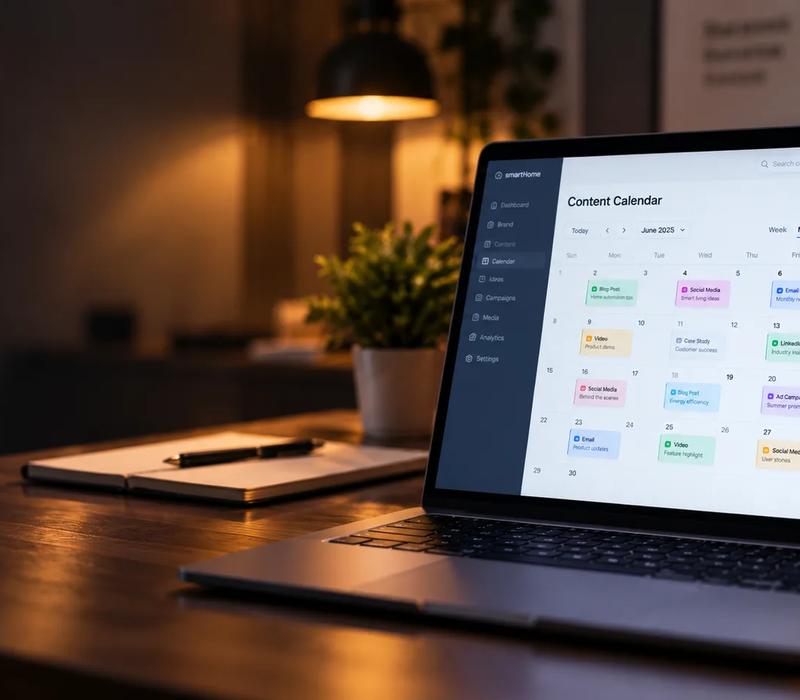
Content planning
A workspace for generating marketing ideas and content based on the business and its goals.

Content editor
A review and editing surface where AI-generated content can be refined before publishing.

Media generation
A dedicated workflow for generating images and videos when a user needs a finished creative asset.
A complete SaaS platform
around the AI.
The result was not a collection of AI demos. It was a production marketing system with the supporting infrastructure required to operate as a SaaS product.
AI became one capability inside a much larger system.
Specialized AI assistants for brand intelligence, strategy, content, and creative workflows sit alongside authentication, teams, permissions, subscriptions, credits, administration, analytics, and content management, plus integrations across social platforms, payment providers, AI providers, advertising, and analytics — all running on serverless infrastructure built for background processing and production scale.

AI layer
Specialized AI assistants for brand intelligence, strategy, content, and creative workflows.
SaaS platform
Authentication, teams, permissions, subscriptions, credits, administration, analytics, and content management.
Serverless infrastructure
AWS Lambda, API Gateway, AWS SAM, isolated environments, background processing, and production deployment workflows.

From a simple proposition to a complete workflow.
The project started with a simple proposition: AI could help businesses create better marketing content. The finished platform turned that proposition into a complete workflow.
Every discipline this build touched.
From product architecture and AI through platform engineering, business systems and integrations — the disciplines behind a production marketing platform.
Product
AI
 OpenAI
Platform
 Next.js
 TypeScript
 MongoDB
 AWS Lambda
Business systems
Integrations
Engineering
The AI idea became
a product a business could actually run.
Brand context became persistent, AI became part of a workflow instead of an isolated model, long-running work became asynchronous, multiple AI providers could coexist, AI costs became part of the architecture, and the product became a real SaaS. The difficult part was never connecting an AI model — it was building the product around it: knowing what context the AI needed, what to do with its output, how to handle failures, how to manage long-running jobs, how to control usage, how to connect external systems, and how to support customers once they started paying for the product. We treated AI as a capability, not the product, and built the product that makes that capability useful.
10+
hrs saved / week
9+ tools
replaced by one workflow
60%
less time for marketing
10+ tasks
automated in one workflow
Other work
from the same team.
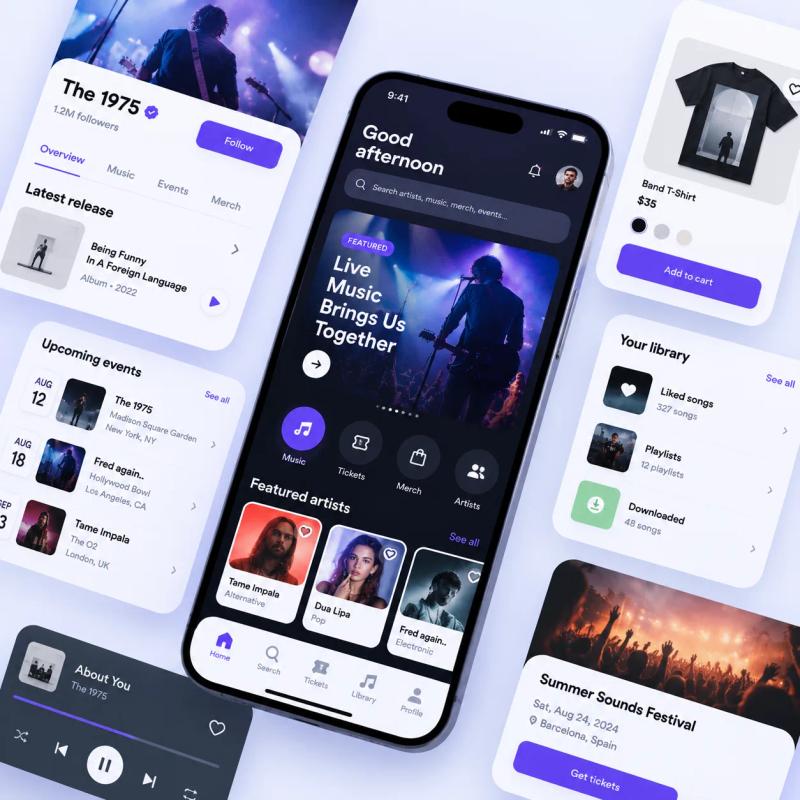
Scattered music systems, now one platform
Distribution, artist and label storefronts, payments, royalties and rights in one place.

Legacy membership workflows, moved to one global platform
Membership, certification and registration for a global professional association, moved to a modern platform.

An ageing subscription platform, modernized module by module
A subscription platform for animal breeders, modernized one module at a time.

Pureblu: the operating system for a pan-India service network
One platform for customers, service partners, technicians, contracts, sales and inventory.


Start a project
Have a similar problem?
Send a brief
We reply within one business day and set up a free 30-minute call.